
Dreams
I dream a lot, like more than any other person I know. It is rare for me to wake up and not know what I was dreaming about. I can usually remember parts of multiple dreams I had throughout the night and if I reinforce the memory by reminiscing about it in the morning, writing it down, or by telling it to someone then I can usually remember it for a lot longer.
This is great for me, as I think dreams are really cool, and hold a lot of potential.
Controlling reality
Let's assume that the universe exists, then in this universe there is a single series of events that have happened, a single set of rules that govern the way it works, and a single future. It is one permutation of how things could be.
We are not omniscient. We build up a mental model of reality based on our experiences. No two people experience the same thing the exact same way, so everyone gets their own unique model, and nobody's model is correct. The world you live in is merely a product of all of your experiences. This is great news, as it means if you control your experiences, you can influence your own mental model, and have control over the world you live in.
You can create experiences for your own mental model by perceiving the real world. You can influence these experiences by mentally trying to change how you perceive them (the kinda stuff they get you to do in therapy). You can more profoundly change how you perceive the real world by taking hallucinogens, or so I've heard...
You can also create experiences by having dreams, where your own mind is manufacturing perceptions for you to experience. With lucid dreaming, your conscious mind even gets control over the world which you are perceiving. I think there is incredible potential in this. It is a way to control your perceptions, which form your experiences, which build your mental model, which define the world you live in.
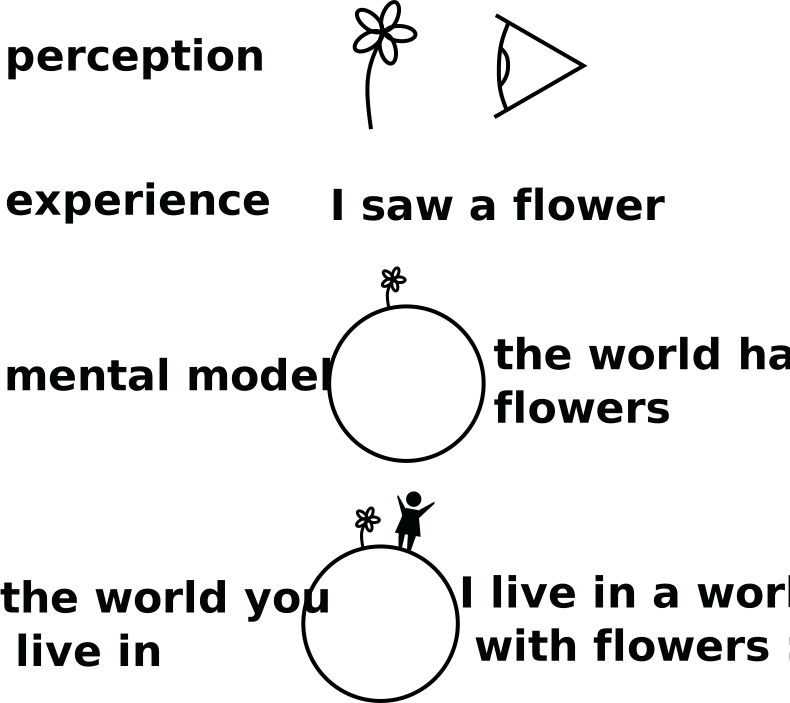
Like most people, I dont have everything I want in life. But, in a world of your own design, you can fix anything you are dissatisfied with. Make a world where you are living a glamorous life, or have superpowers, or a billion dollars, or make a world where money doesnt exist, or where technology never left the stone age. Literally anything you can imagine.
There are a few problems with this.
- We dont have complete control over our dreams.
- You probably dont care about what happens in your dreams as much as you care about what happens in real life.
- You can't stay in your dreams forever, you have to wake up eventually, and that breaks the illusion.
I intended to answer all of these and convince you to join me in the dream world, or at least not judge me for absconding to it. However, there is a New Shiny Thing™, that I simply must devote myself to. So I may come back to this in like a few months, or maybe a year...
What makes the memory of an experience valuable?
The emotions you experienced seem like the most important factor. You want to remember a great time you had with your friends, even if your life wouldn't be noticeably different had it not happened.
The experience having consequences that are still relevant seems like it adds value. If that great night with your friends led to you moving to another country, then you really wouldn't want to forget it. Its potential to impact you now, and in the future, matters. Why? if it leads to positive results, you want to remember it so you can replicate it. if it leads to negative results, you want to remember it so you can avoid it. but then wouldnt rememering it hold the same value as someone just telling you about it? No, becuase you trust firsthand experiences a lot more.
How interesting the experience was (largely driven by novelty) also feels really important. I don't care about the memory of eating breakfast yesterday even though experience had the lasting consequence of keeping me alive, but I do care about the memory of my first kiss.
I value the memory of pleasant experiences more than negative ones, which sounds obvious, but given the choice I certainly wouldn't forget most of my negative experiences, especially not the really negative ones. That may be because my most negative experiences have had a large impact on who I am, so they have consequences that are still relevant, or it may just be that they are interesting because of how negative they were.
I feel like most people will put a lot of weight on whether the experience was real and not fabricated. But, as explored by the idea of last thursdayism, you can't actually prove that any of your experiences happened. So maybe the experience being real only adds value because it's a precondition to it having ongoing consequences that could impact things in the future.
I feel like nobody values the memories of their dreams. I think this is entirely because they dont have lasting consequences. If you woke up every night into the same dream world, where you were the same person, with the same goals, friends, achievements, etc. I think people would be less likely to devalue that world. I also think if their dreams could somehow impact reality, then the memory of their dream's value would match that of reality.
I accept that dreams do not hold the same utility as real world experiences when it comes to learning. You can learn things from real life experiences as the real world tends to be relatively consistent. If touching the hot stove hurt yesterday, its probably going to hurt today. You cant learn from dreams the same way, as there is no guarentee that your dream logic will match real life. You could fly in your dream last night, but if you jump off a building in real life its probably not going to end well.
How do we know which memories are real?
- It is logically consistent. Every time you experience it, the same rules apply as the previous times.
- It is temporally consistent/doesnt have continuity errors. Things that happened in the past dont unhappen, and if theres no lasting evidence of them, then there is a reasonable explanation for that.
We usually beleive we are experiencing reality, so if the memory is consistent with our current perception of reality, we will think it is real.
We build up our perception of reality, not from what has actually happened, but from what we perceive, our experiences. In order to make our dreams indistinguishable from reality, all they have to do is follow the rules
bLURURR im gonna go do something else